How Long Are Car Seats Good For? What Parents Know
You open the trunk and pull out the car seat your neighbor gave you. It looks clean. The straps move fine.
The buckles click. But somewhere on that plastic shell, probably on the bottom or under the fabric, there is a date stamp you haven’t found yet. And that date matters more than how the seat looks.
Because the real question isn’t whether a car seat appears safe. It’s how long are car seats good for before the materials themselves start breaking down.
Manufacturer specifications indicate that most car seats expire between 6 and 10 years from the date of manufacture, depending on the brand and model. This isn’t a random number the company picked to sell more seats. It’s based on materials science.
The polypropylene shell, the EPS foam, and even the harness webbing degrade over time. Heat cycles, UV exposure, and simple age change the plastics on a molecular level. As of 2026, every car seat sold in the United States must carry a visible expiration or manufacture date.
Finding and understanding that date is the first real step in keeping a child safe on the road.
Quick Answer
Car seats are good for 6 to 10 years from the date of manufacture. Infant seats typically expire at 6 years. Convertible seats last 6 to 10 years depending on the brand.
Boosters often run 8 to 10 years. The exact number is printed on your seat. Check the sticker.
Never guess.
Why Car Seat Expiration Matters More Than You Think
The expiration date on a car seat is not a marketing gimmick. It is a safety cutoff based on how materials behave over time. Our research into industry standards and manufacturer documentation confirms that the plastics used in car seat shells are engineered to absorb crash energy in a very specific way.
They flex and crack in a controlled manner to slow the child’s forward motion. That property changes as the plastic ages.
Polypropylene, the most common shell material, undergoes a process called UV degradation. Even if you never leave the seat in direct sunlight, the small amount of UV light that reaches it through car windows slowly breaks the polymer chains. The plastic becomes more brittle.
Instead of flexing and absorbing impact in a crash, an older shell can shatter or crack unpredictably. That difference can mean a child absorbs forces the seat was designed to reduce.
Temperature also plays a role. A car’s interior can easily hit 140 degrees Fahrenheit on a summer afternoon. That heat cycling, day after day, year after year, accelerates the aging of both the plastic and the foam.
The EPS or EPP foam that cushions the head and chest becomes less effective at compressing during an impact. The harness webbing can weaken. The LATCH connectors can fatigue.
This is why manufacturers set a firm date. They have tested these seats for performance through that window. Beyond it, they cannot guarantee the seat will perform as designed.
No amount of careful handling or garage storage changes the chemical reality of what happens inside the plastic.
The second reason expiration matters is crash history. A seat that has been through a moderate or severe crash has already absorbed forces that may have compromised its structure. Even if it looks fine, manufacturers universally require replacement after such a crash.
You cannot inspect your way to safety on this one. Microscopic cracks in the plastic or compressed foam cannot be seen with the naked eye.
So the expiration date serves two purposes. It marks the end of the seat’s reliable service life for material reasons. And it provides a clean starting point for a new seat with full crash protection.
If you are sorting through baby gear for your first child or getting ready for a new arrival, understanding when that seat expires is as important as knowing the right way to get your newborn home from the hospital safely.
Core Facts: The Science Behind Plastic Degradation
Car seat shells are made from polypropylene. This is a thermoplastic polymer chosen specifically for its ability to absorb energy by flexing and deforming. It is the same material used in many automotive bumpers and industrial packaging.
But like all plastics, it has a finite service life.
The degradation happens at the molecular level. UV radiation provides enough energy to break the carbon-carbon bonds in the polymer chain. This is called chain scission.
As the chains shorten, the plastic loses its toughness and becomes more brittle. The effect is cumulative and irreversible.
Heat accelerates this process. The Arrhenius equation in chemistry tells us that chemical reaction rates roughly double for every 10 degree Celsius increase in temperature. A car seat living in a Phoenix garage or a Florida back seat experiences this acceleration every day of its life.
The practical result is that a six-year-old seat from a hot climate may be materially older in molecular terms than the same seat stored in a cool basement in Minnesota for the same calendar period.
Manufacturers account for this by setting conservative expiration dates. They test their seats to perform through a specific number of heat cycles, UV exposure hours, and mechanical stress events. The expiration date represents the end of that tested window.
The foam inside the seat is just as important. EPS and EPP foams are energy absorbing materials. They work by crushing and compressing during impact.
Over time, these foams can lose their ability to compress properly. They become stiff or brittle. A seat with degraded foam can transmit more force to the child’s head and chest during a crash.
The harness webbing is made from polyester. It is strong and durable, but it can also degrade with UV exposure and sweat. Manufacturers test the webbing for tensile strength at the beginning and at the expiration point.
They set the date where the webbing still meets federal strength standards under FMVSS 213.
This may sound like a lot of science for something as simple as a car seat. But the key takeaway is straightforward. The materials in a car seat have a service life.
The manufacturer knows what that life is and prints it on the seat. Trust the number, not your eyes.
Car Seat Lifespan by Type (Infant, Convertible, Booster)
Not all car seats expire on the same timeline. The type of seat and its construction determine how long it stays within its tested window. Here is how the three main categories break down.
Infant car seats typically have the shortest lifespan at 6 years from the date of manufacture. These seats are smaller and have a base that stays in the car. The base itself has an expiration date separate from the carrier, though they usually match.
Why only 6 years? Infant seats get handled more. They are clicked in and out of bases, carried around, and exposed to more environmental variability.
The plastic is thinner than a convertible because the seat is designed to be portable. Six years is the standard across most brands including Graco, Chicco, and Evenflo.
Convertible car seats last longer, usually between 6 and 10 years. These seats are built with a more robust plastic shell because they are designed to stay installed for years. They transition from rear-facing to forward-facing and often have higher weight limits.
The larger shell and thicker plastic allow for a longer lifespan. Britax convertibles typically run 7 to 9 years. Graco convertibles run 7 to 10 years.
Nuna convertibles run 8 to 10 years. Always check the sticker on your specific model.
All-in-one seats that go from rear-facing through booster mode generally have a lifespan of 7 to 10 years. These are large seats with multiple configurations. The booster mode at the end of the seat’s life means you get the most use out of the longest possible window.
But remember the clock starts ticking the day the seat is manufactured, not the day you start using it in booster mode.
High-back booster seats typically last 8 to 10 years. Because booster seats use the vehicle’s seat belt rather than a harness system, the stresses on the shell are lower. The seat is essentially positioning the child for the adult belt rather than restraining them through a harness.
This allows for a longer service life. No-back boosters, which are essentially just a cushion and belt guides, often have the longest expiration windows at 8 to 10 years.
Combination seats that go from harness to booster have lifespans in the 7 to 10 year range. These are convertible seats that lose the harness and become a belt-positioning booster when the child outgrows the harnessed mode.
Here is a quick reference table showing typical lifespans by seat type. Always confirm on your own seat because brand policies vary.
| Seat Type | Typical Lifespan | Notes |
|---|---|---|
| Infant seat | 6 years | Shortest window. Check base and carrier. |
| Convertible | 6 to 10 years | Varies by brand. Check specific model. |
| All-in-one | 7 to 10 years | Longest usable life of multi-mode seats. |
| High-back booster | 8 to 10 years | Less structural stress. Longer window. |
| No-back booster | 8 to 10 years | Simplest design. Longest lifespan. |
| Combination | 7 to 10 years | Harness mode first, then booster. |
The expiration date is always measured from the date of manufacture, not the date of purchase. A seat that sat on a warehouse shelf for two years before you bought it is already two years into its service life. Always check the manufacture date before buying a new seat, especially from second-hand sources or clearance sales.
Comparing Brand Expiration Policies (6, 7, or 10 Years)
Not all manufacturers agree on how long a car seat should last. Some are conservative at 6 years. Others push to 10.
Understanding these differences helps you know what to expect and why one brand may be a better choice depending on your family plan.
6 year expiration brands are the most conservative. Many infant seats fall into this category. The logic is that infant seats are portable, handled frequently, and used in more varied environments.
They also tend to have thinner shells. If you plan to have several children close together, a 6 year seat may still work for hand-me-downs. But if there is a larger age gap, the seat may expire before your youngest outgrows it.
Some 6 year brands include most infant-only models from major manufacturers.
7 year expiration brands are the most common for convertible seats. Graco typically sets 7 years on its convertible and all-in-one seats. Britax runs 7 to 9 years depending on the specific model.
Evenflo uses 8 years on many of its newer seats. Seven years is a reasonable window for one or two children spaced a few years apart.
8 to 10 year expiration brands give you the longest usable life. Clek and Nuna have some models that reach 10 years. Diono convertibles often run 8 years.
These longer windows are helpful if you have a larger age gap between children or if you want the seat to last through multiple kids. The trade-off is that these seats tend to be heavier and more expensive. The longer lifespan justifies the higher price if you plan to keep the seat in use for the full decade.
Here is a comparison of major brand expiration policies. These are typical ranges. Always verify on your specific model.
| Brand | Typical Lifespan | Notes |
|---|---|---|
| Graco | 7 to 10 years | Most convertibles run 7 years. |
| Britax | 7 to 9 years | Model dependent. Check label. |
| Chicco | 6 to 8 years | Infant seats are 6 years. |
| Evenflo | 6 to 8 years | Newer models often 8 years. |
| Nuna | 8 to 10 years | Longer window on most models. |
| Diono | 8 years | Convertibles and all-in-ones. |
| Clek | 9 to 10 years | Premium seats. Longest window. |
If you are buying a seat that will pass through multiple children, a longer expiration window makes financial sense. You get more years of use per dollar. But never buy a seat solely on expiration length.
Fit, ease of installation, and safety ratings matter more than the calendar date alone. A seat that expires in 10 years but is difficult to install correctly every time is less safe than a 7 year seat that you install properly without errors.
One more thing to keep in mind. The expiration date applies to the entire seat assembly. For infant seats, this includes both the carrier and the base.
They often share the same date, but check both. For convertible seats, the date applies to the seat itself. For boosters, the date is on the plastic shell.
The LATCH system on the seat also expires with the seat, though the vehicle LATCH anchors do not.
Now that you know how long each type lasts and how brands compare, the next step is finding the actual date on your seat. That is where many parents get stuck, because the expiration sticker is not always easy to find.
How to Find Your Car Seat’s Expiration Date (Step by Step)
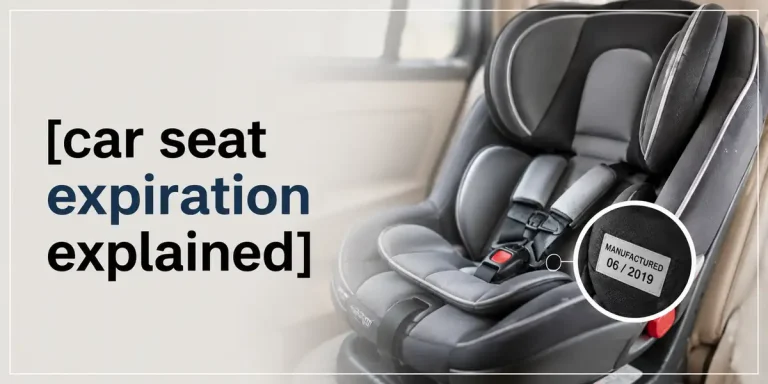
Every car seat has an expiration date stamped somewhere on the shell. The most common location is on the bottom or the back of the seat. You may need to remove the fabric cover to see it.
Look for a sticker or a molded-in label that says something like “Expiry date” or “Do not use after” followed by a month and year.
Some brands print the date of manufacture instead. If you see a DOM sticker with month and year, add the seat’s lifespan (6, 7, 8, or 10 years) to get the expiration date. Infant seats often have the date on the carrier shell and on the base separately.
Check both because they can differ.
If the sticker is worn off or unreadable, do not guess. Contact the manufacturer with the model number and serial number. You can find those numbers on a separate label usually located on the side of the seat or under the cover.
Without a readable date, the seat should be treated as expired and replaced immediately. It is not worth the risk.
What Happens After a Crash – When You Must Replace Immediately
A car seat that has been in a moderate or severe crash must be replaced. NHTSA defines a moderate crash as one where the vehicle was damaged enough that it could not be driven from the scene. Even if the seat looks fine, the internal foam and plastic shell may have absorbed forces that compromise future performance.
Minor crashes where the vehicle was driven away and the seat was not directly impacted may not require replacement. Per NHTSA guidelines and manufacturer recommendations, a crash qualifies as minor if all of these are true: the vehicle was drivable, the door nearest the seat was undamaged, no one in the vehicle was injured, and the airbags did not deploy. If any of those conditions are false, replace the seat.
Never buy a used car seat with an unknown crash history. A seat that looks clean could have been through a serious crash. The plastic may have microcracks you cannot see.
The foam may be compressed. The only safe used seat is one that comes from a trusted source who can confirm it has never been crashed and is not expired. If you have any doubt, skip it and buy new.
Safe Disposal: Cutting Straps, Removing Foam, and Recycling Options
An expired or crashed car seat should never be resold, donated, or passed on. The safest way to dispose of it is to make it unusable. Start by cutting the harness straps completely through.
Remove the cover and cut the foam padding. Use a screwdriver to break the plastic shell in several places.
Do not simply throw it in the trash whole. Someone may pull it out and use it. Render it clearly non-functional.
Some municipalities have specific recycling programs for car seats through waste management services. Check with your local solid waste district.
Several retailers run annual trade-in events where you can bring an expired seat and receive a discount on a new one. Target usually holds these in April and September. Walmart and some local fire departments also host events.
The discounted seat is often the safest option because you get a brand new seat with a full lifespan ahead of it. But even without a trade-in, destroying and trashing the seat is better than leaving it for someone else to misuse.
Common Mistakes Parents Make with Expired Seats
The most common mistake is judging by appearance. A seat that looks and feels brand new can still be expired. Plastic degradation is invisible to the naked eye.
Do not rely on the condition of the straps or the foam. Trust the date stamp.
Another mistake is using a seat that was stored in a hot attic or garage for years. Even if the date is still valid, the extreme heat may have accelerated material aging. If you find a seat that has spent multiple summers in a hot storage space, consider it compromised.
The manufacturer’s expiration assumes normal temperature exposure.
Parents also forget to register their seat for recalls. An expired seat is not covered by recall replacement anyway, but registering helps you stay informed about safety issues for the seat you are currently using. You can register on the manufacturer’s website or at SaferCar.gov.
Finally, many people assume the expiration date starts when they buy the seat. It starts from the date of manufacture. A seat that sat in a warehouse for two years before you bought it has already used up two years of its service life.
Always check the DOM before purchasing. If you buy a seat that is already two years old, you are getting less use than expected.
State Laws and NHTSA Compliance – What’s Required vs Recommended
Federal regulations under FMVSS 213 require all car seats sold in the US to have a manufacture date and an expiration date. As of 2026, this is mandatory. No seat can be sold without clear labeling.
The law also requires crash testing at the beginning and end of the labeled lifespan.
State laws vary on car seat usage, but none specifically require you to replace an expired seat. However, using an expired seat could leave you legally vulnerable if a crash occurs. Insurance companies may argue that the seat was not in compliance with its own manufacturer’s safety guidelines.
That can complicate a claim.
NHTSA strongly recommends replacing car seats that are past their expiration date. The agency’s SafeRide program and nationwide inspection events emphasize this point. If you bring an expired seat to a car seat check event, the technician will not inspect it.
They will tell you it needs to be replaced immediately.
In Canada, the rules are slightly stricter. Transport Canada recommends a maximum lifespan of 7 to 9 years depending on the seat type. Many Canadian seats have a fixed 7 year expiration.
If you live near the border or buy a seat from Canadian retailers, be aware of these differences.
The bottom line is clear. The law requires the date to be visible. Experts recommend replacing the seat when that date passes.
No state requires an expired seat to be destroyed, but no safety authority says you should keep using it. The safest choice is straightforward. If it is expired, get a new one.
Expert Tips on Storing Your Seat to Maximize Lifespan
Store your car seat in a climate controlled space. A garage that hits 140 degrees in summer will age the plastic faster than a bedroom closet. Keep it out of direct sunlight.
UV rays break down polypropylene even through window glass.
If the seat lives in your car permanently, use a sunshade on the rear window. This cuts UV exposure significantly. Remove the seat from the vehicle during extreme heat waves if you can.
Park in the shade when possible.
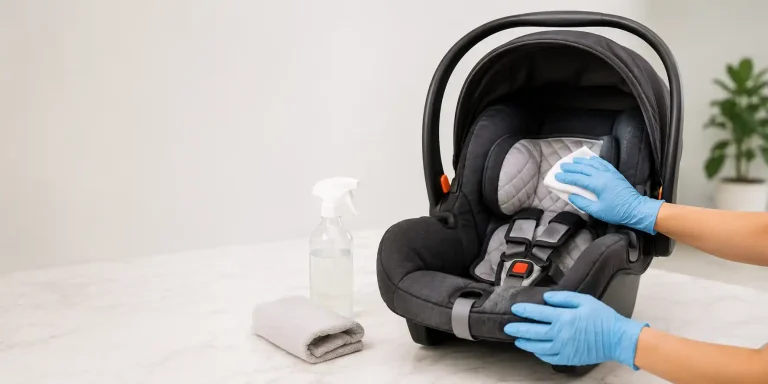
Clean the harness straps with mild soap and water only. Harsh chemicals can weaken the webbing. Never submerge the straps.
Never put them in the washing machine. Spot clean and air dry.
When to Ignore the Date (and When to Never Ignore It)
Never ignore the expiration date for primary use. If your child rides in this seat daily, the date is hard. Replace it when it passes.
The only time you might consider keeping an expired seat is as an emergency spare. A booster that is one year past date and used once a year for a neighbor’s child in a low speed school run may still provide some positioning benefit. But this is a calculated risk.
The American Academy of Pediatrics recommends replacement at expiration without exception.
For air travel or rental cars, many families buy an inexpensive travel seat and accept a shorter lifespan. That is a different calculation. But for daily driving, the date is non-negotiable.
Trust it.
Final Decision Guide: Keep, Replace, or Trade In?
Here is a simple framework. If the seat has passed its printed expiration date, replace it. If it has been in a moderate or severe crash, replace it.
If it is from an unknown source or has an unreadable date sticker, replace it.
If the seat is still within its date range and has no crash history, keep using it. Register it for recalls if you have not already. Set a calendar reminder for the expiration date so you do not miss it.
If the seat is expired but still in good physical condition, check for trade in events. Many retailers offer a discount on a new seat when you bring in an expired one. This is the most cost effective way to replace a seat that has reached the end of its service life.
Frequently Asked Questions
How long are car seats good for from the date of manufacture?
Most car seats last 6 to 10 years from the date of manufacture. Infant seats tend to expire at 6 years. Convertible seats last 6 to 10 years depending on the brand.
The exact number is printed on the seat.
Can I use a car seat after it expires?
No. An expired car seat may not provide full protection in a crash. The plastic shell and foam degrade over time.
Replace it immediately.
How do I find the expiration date on my car seat?
Look on the bottom or back of the plastic shell. You may need to remove the fabric cover. The date is either an explicit expiration or a date of manufacture that you add the lifespan to.
Can I use a used car seat from a friend?
Only if you can confirm it has never been in a crash and is not expired. Check the date sticker. Ask about crash history directly.
If there is any doubt, buy a new seat.
What should I do with an expired car seat?
Cut the straps, break the plastic shell, and discard it. Do not donate or resell it. Some retailers accept expired seats for trade in events.