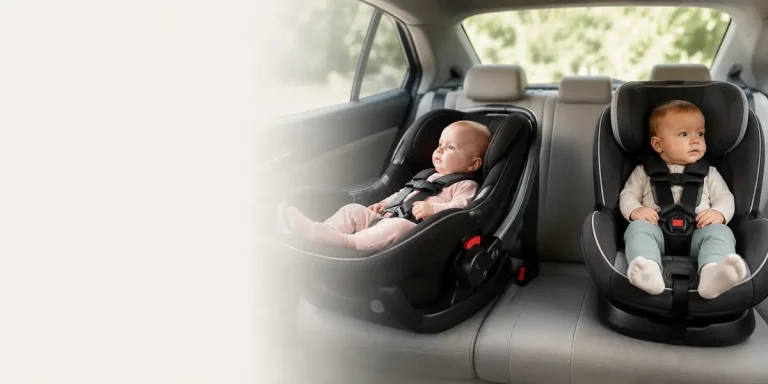
When Can You Front Face Baby in Car Seat? Parent Guide
You’re probably wondering when can you front face baby in car seat, and the answer isn’t as simple as a birthday. Most parents hear “2 years old” and assume that’s the magic number, but the real answer depends on your specific car seat, your child’s measurements, and a few safety rules that go beyond what the law requires.
The American Academy of Pediatrics recommends keeping children rear-facing until at least age 2, but the safest approach is to keep them rear-facing until they hit the maximum height or weight limit of their convertible car seat. As of 2026, most convertible seats on the market allow rear-facing up to 40 to 50 pounds, which means many kids can safely stay rear-facing until age 3 or even 4. Let’s walk through exactly how to know when your child is truly ready.
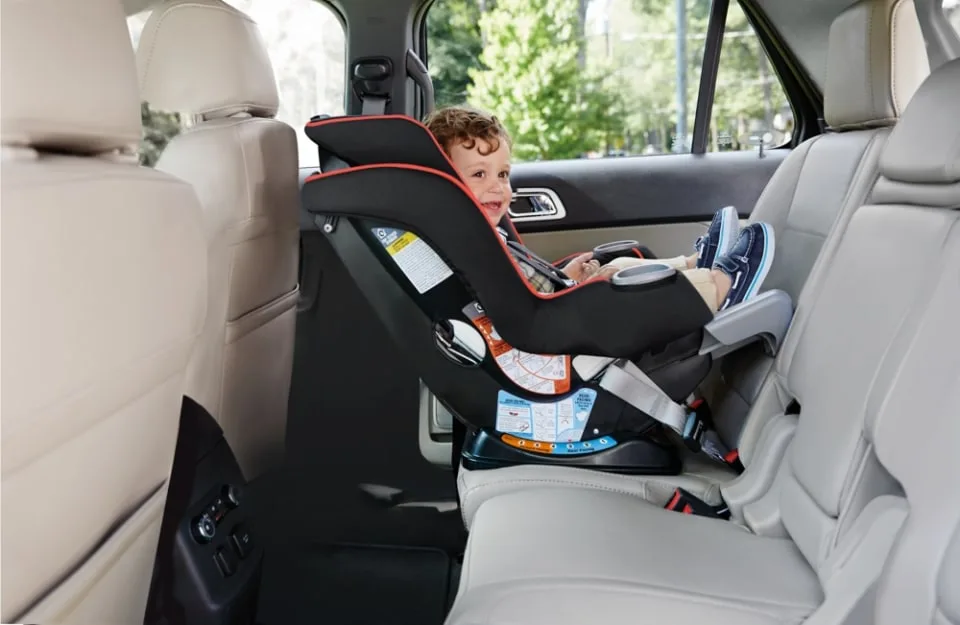
Image source: Bing (Web (fair-use with source credit))
Why This Decision Deserves More Than a Quick Google Search
Here’s the thing about car seat safety: it’s not a one-size-fits-all answer. Your neighbor’s 2-year-old might be ready to turn around while your 2-year-old absolutely isn’t, and that’s not because one of you is doing something wrong. It’s because car seats have different limits, and kids grow at different rates.
The stakes are genuinely high. Car crashes are a leading cause of death for children in the United States, and the way a child is restrained in a crash makes a massive difference in injury outcomes. Rear-facing seats distribute crash forces across the entire back and head, keeping the neck and spine in a neutral position.
Forward-facing seats, by contrast, put those same forces directly on the harness straps and the child’s developing spine.
State laws are the absolute minimum, not the gold standard. Most states require rear-facing until at least age 1 and 20 pounds, but that’s decades behind the current research. Following the law alone means you could be putting your child at significantly higher risk than necessary.
That’s why pediatricians, car seat manufacturers, and child passenger safety technicians all recommend going well beyond the legal minimum.
The good news? Making the right call isn’t complicated once you understand the three rules that actually matter. We’re going to break them down so you can make an informed decision with confidence, not guesswork.
The Quick Answer: What the Experts Actually Say
Turn your child forward-facing only after age 2 AND when they exceed the rear-facing height or weight limit of your specific car seat. The American Academy of Pediatrics recommends keeping kids rear-facing to the maximum limit of the seat. Most convertible seats allow rear-facing to 40-50 pounds.
Check your manual for exact numbers. When in doubt, keep them rear-facing longer.
The 3 Real Rules: Age, Weight, and Height Limits
Let’s get into the actual criteria that determine when your child can safely face forward. There are three separate rules, and your child must meet all three before you make the switch. Missing even one means they’re not ready.
Rule 1: Age (Minimum 2 Years)
The age minimum is exactly that, a minimum. It’s not a target or a goal. The American Academy of Pediatrics set this as the absolute earliest point a child should face forward, based on crash data showing that children under 2 are at significantly higher risk of spinal injury in forward-facing crashes.
But here’s what most parents don’t realize: age 2 is the starting line, not the finish line. Many experts now recommend keeping kids rear-facing until age 3 or 4, simply because the skeletal system is still developing. The vertebrae in a toddler’s spine are not fully ossified, meaning they’re still mostly cartilage.
That makes them far more vulnerable to the forces of a forward-facing crash.
Rule 2: Weight (Check Your Seat’s Specific Limit)
Every convertible car seat has a rear-facing weight limit printed on its label. This number typically falls between 30 and 50 pounds, depending on the brand and model. Your child must be at or below this limit to remain rear-facing, and they must be at or above the forward-facing minimum weight (usually 20 to 22 pounds) to turn around.
The weight limit isn’t just a suggestion. It’s the maximum load the seat’s shell and harness are designed to handle in a rear-facing crash. Exceeding it means the seat may not perform as intended, which is why manufacturers test and certify their seats to specific limits.
Rule 3: Height (The 1-Inch Rule)
Height is where most parents get confused. The rule is simple: your child’s head must be at least 1 inch below the top of the car seat shell when rear-facing. If the top of their head is level with or above the top of the shell, it’s time to turn them around, even if they haven’t hit the weight limit.
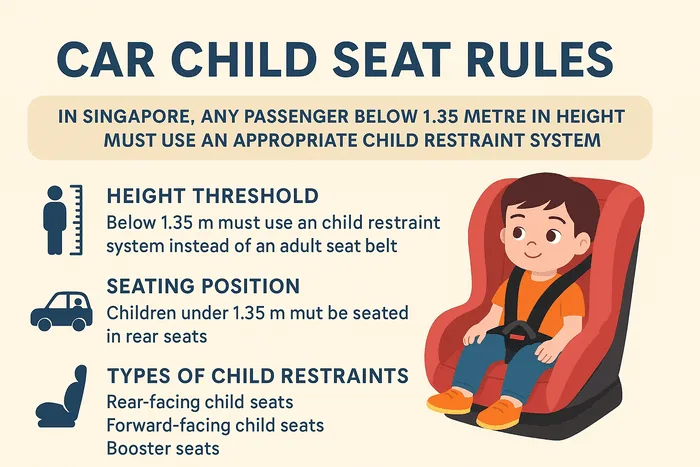
Image source: Web (Bing) / transportchronicle.com (Web image (fair-use with source credit))
This rule exists because the seat shell provides critical head and neck protection in a crash. If the head extends above the shell, that protection is compromised. Some seats also have a maximum rear-facing height limit printed on the label, so check both the label and the manual.
Why All Three Rules Matter
Here’s a common scenario: your 2-year-old weighs 28 pounds, and your seat allows rear-facing up to 40 pounds. They’re under the weight limit, but if their head is already at the top of the shell, they’ve outgrown the seat rear-facing. Time to turn them around.
Another scenario: your 3-year-old weighs 35 pounds, well under the 40-pound limit, and their head has plenty of room. They can absolutely stay rear-facing, and they should. The age minimum is just a floor, not a ceiling.
How to Check Your Car Seat’s Specific Limits
You can’t make an informed decision without knowing your specific seat’s numbers. Here’s exactly how to find them.
Step 1: Look at the Label
Every car seat has a white or yellow label permanently attached to the side or back of the seat. This label lists the model number, manufacture date, and all weight and height limits for both rear-facing and forward-facing modes. It’s the most reliable source of information for your specific seat.
Step 2: Read the Manual
The manual goes into more detail than the label. It explains how to adjust the harness, where the top tether anchor is, and any specific installation requirements for forward-facing mode. If you’ve lost the manual, most manufacturers have PDF versions on their websites.
You can also contact customer service and request a replacement.
Step 3: Measure Your Child Accurately
You’ll need your child’s current weight and height. Weigh them at home on a digital scale, or use the scale at your pediatrician’s office. For height, have them stand against a wall with their heels flat and measure from the floor to the top of their head.
If they won’t stand still, lay them flat on a measuring mat or use a tape measure.
Step 4: Check the Head Position
With your child sitting in the seat rear-facing, check where the top of their head sits relative to the top of the seat shell. You need at least 1 inch of clearance. If they’re right at the line, it’s time to consider the switch.
Step 5: When in Doubt, Get a Professional Check
Child passenger safety technicians (CPSTs) are trained to help parents with exactly this kind of decision. They can verify your installation, check your child’s fit, and confirm whether it’s truly time to turn the seat. Many fire stations, hospitals, and police departments offer free car seat checks.
It’s worth the 30 minutes for the peace of mind.
The Crash Science: Why Rear-Facing Is Safer (Even at Age 3)
Let’s talk about what actually happens in a crash, because understanding the physics makes the recommendation much easier to accept.
What Happens in a Forward-Facing Crash
When a car hits something and stops suddenly, the child’s body keeps moving forward at the speed the car was traveling. In a forward-facing seat, the harness catches the child’s shoulders and chest, but the head and neck continue moving forward. This creates a whiplash effect that puts tremendous stress on the cervical spine.
For a toddler whose vertebrae are still mostly cartilage, that stress can cause serious injury. The spinal cord can stretch, tear, or even sever. This is called “internal deceleration injury,” and it’s the primary reason rear-facing is so strongly recommended.
What Happens in a Rear-Facing Crash
In a rear-facing seat, the child’s entire back, head, and neck are supported by the seat shell. The crash forces spread across the whole body rather than concentrating on the harness straps. The head and neck stay in a neutral position, which dramatically reduces the risk of spinal injury.
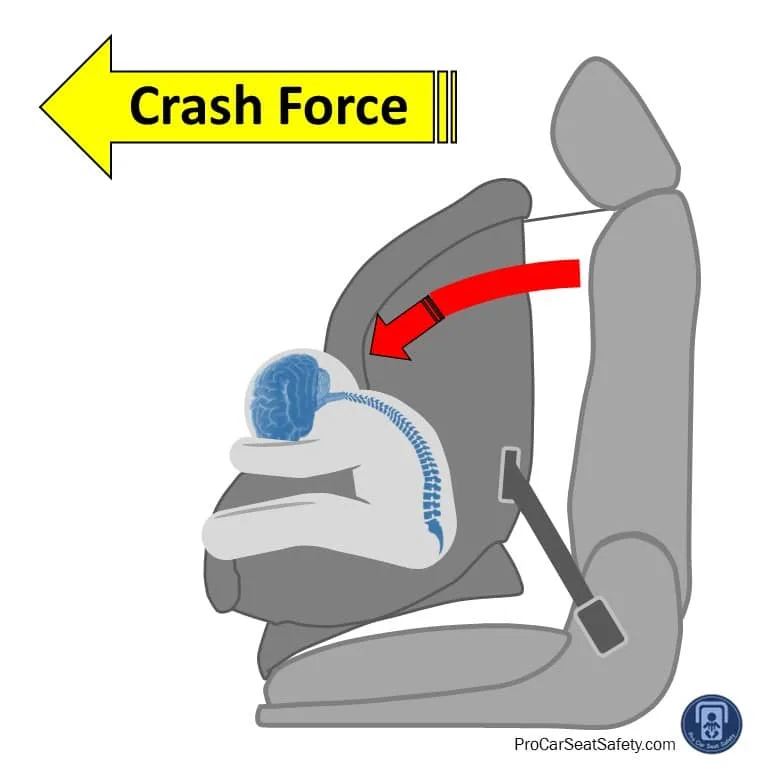
Image source: Web (Bing) / procarseatsafety.com (Web image (fair-use with source credit))
The data backs this up. Research published by the American Academy of Pediatrics found that children under 2 are 5 times more likely to be seriously injured in a forward-facing crash compared to a rear-facing crash. That’s not a small difference.
That’s the difference between walking away and a hospital stay.
The “Legs Touching” Concern
Parents often worry that rear-facing is uncomfortable because their child’s legs are bent or touching the back of the vehicle seat. Here’s the truth: it’s completely fine. Children are flexible, and they naturally find comfortable positions.
They’ll cross their legs, prop their feet on the seat, or tuck their knees up. None of this is dangerous.
What’s more dangerous is turning them forward-facing too early. Leg injuries are treatable. Spinal injuries are not.
Pediatric orthopedists consistently confirm that rear-facing leg positioning does not cause long-term damage, even when kids ride that way for years.
The Bottom Line on the Science
Rear-facing is the safest way for young children to ride, period. The longer you can keep them rear-facing, the better protected they are. The American Academy of Pediatrics recommends keeping children rear-facing until they reach the maximum height or weight limit of their convertible car seat, which for many kids means age 3 or 4.
That’s not overprotective parenting. That’s following the evidence.
The Real Risks of Turning Forward-Facing Too Early
If you’re feeling pressure to turn your child around, whether from a spouse, a grandparent, or just the desire to see their face in the rearview mirror, let’s talk about what’s actually at stake.
The Injury Data
The most compelling reason to delay the switch is the injury data. Children under 2 who ride forward-facing are 5 times more likely to sustain serious injuries in a crash than those who ride rear-facing. These injuries include head trauma, spinal cord damage, and internal organ injuries.
The difference is stark, and it’s why every major safety organization recommends extended rear-facing.
The “It’s Legal” Trap
State laws are the absolute minimum standard, and they lag far behind the research. Most states require rear-facing only until age 1 and 20 pounds. Following the law alone means your 18-month-old could legally face forward, but they’d be at significantly higher risk of injury.
Legal doesn’t mean safe. It means the state has set a floor, not a ceiling.
The Pressure Problem
It’s hard to keep a toddler rear-facing when they’re crying, when you can’t see them, or when your mother-in-law insists “you turned around at 1 and you turned out fine.” But survivorship bias is real. The kids who were injured in forward-facing crashes aren’t around to tell their stories. The ones who were fine got lucky, and luck isn’t a safety strategy.
What the Experts Recommend
Child passenger safety technicians, pediatricians, and car seat manufacturers all agree: keep your child rear-facing to the maximum limits of the seat. That’s not a controversial position. It’s the consensus of every major safety organization, including the American Academy of Pediatrics, the National Highway Traffic Safety Administration, and Safe Kids Worldwide.
If your child is approaching the rear-facing limits of their seat, that’s the time to start shopping for a seat with higher limits, not the time to turn them around. Many convertible seats now allow rear-facing up to 50 pounds, which means most kids can stay rear-facing well into preschool.